JANUARY | 22📰
What's been going on in the month of exams and stress

January, the month that ended our 2022. I spent my January working at home on art projects, culminating assignments, exam preparation, Gene Editing research, and more! Although it was a heavy month, there were many uplifting events, such as the TKS Focus Hackathon. So, let’s get into January 2022.
Monthly Mindset - Stoicism 💪:
Stoicism proposes that your response to any given situation is a choice, and it is your responsibility to how you react. A stoic mindset involves a calm and rational approach to life, focusing on inner virtue and wisdom, and avoiding excessive attachment to external events or circumstances.
It comes from Athens by Zeno of Citium (Cyprus). Originating in 300 B.C.E., it was influenced by many people, including Socrates and the Cynics. The core concept of stoicism is a virtue. The Stoics divided it into four types of virtue: justice, courage, moderation, and wisdom. In the modern day, the mindset of stoicism is practiced by many. People believe it can solve many issues brought up in life.
I first came across stoicism a few years ago when I was studying Buddhism. Both Stoics and Buddhists agree that pain is real, but it comes from the mind. Buddhism believes that one can eliminate pain by detaching themselves from their desires, whereas Stoics eliminate pain by controlling their judgement of external events.
By implementing stoicism in my own life, I had a couple of takeaways:
It’s not a “first-time is perfect” thing
When I first started practicing this I realized that it took a lot of practice and patience.
You can’t just do it at the moment, you have to always be practicing it
After learning and implementing a more Stoic mindset, I noticed that you have to always practice it. You can’t wait until a big event happens and expect to control your reaction as well as you’d like, you need to always think about how you’re reacting, even to small things.
3 Noteworthy Pieces of Content📚:
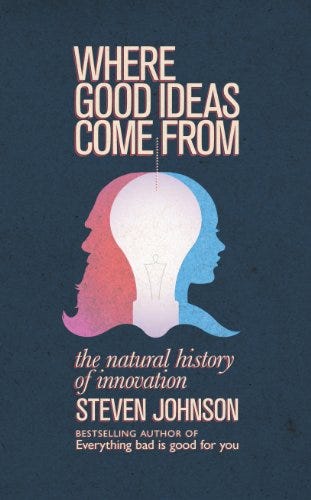
Where Good Ideas Come From
This month I decided wanted to read a book about innovation. Since the summer I have picked up many books on innovation, but none were like this. In 2010, Steven Johnson published Where Good Ideas Come From The Natural History of Innovation. The main concept of the book is “Both evolution and innovation thrive in collaborative networks where opportunities for serendipitous connections exist.” Johnson highlights the amount of serendipity in innovation, and the evolution of a “good idea.”
What makes this book unique to me is its explanation of the history of innovation. It ties into various examples, including Charles Darwin, the Soviet Union, and Jules Henri Poincaré. Johnson used many techniques to make innovation, and it’s history, understandable and engaging. Overall, I took a lot away from this book and would 100% recommend it to anyone curious about where good ideas come from.
BBC Earth Podcast
This month I found out about BBC’s Earth Podcast. When I started listening to this I questions “why have I never listened to this before?!” Personally, I love nature. Nature shows, nature documentaries, nature podcasts, I find them all fascinating. Once I started listening to BBC’s Earth Podcast, I couldn’t stop listening. Each episode covers multiple different themes in nature, and then they get deeper into it. It gives insight into many different scientific concepts that you don’t usually hear, or read, about. With each 30-minute episode, you will learn many new and interesting facts.
Winter Playlist
Lastly, my winter playlist. Since it’s winter, I rotate my music again. This playlist is a compilation of all the winter favourites (and some of my personal favourite songs). If you’re looking for a change in music, join me!
2 Memorable Events 📸:
TKS Focus Hackathon
On Saturday, January 20-21, TKS held a 24h hackathon. We were prompted to solve a global problem that would be implemented by 2030. I and my team (Ilana Moshkovich, Krish Mendapara, Shanzeh Haji, and Maahi Raut) decided to work from 9:00 am - 5:00 pm (when it was due) to complete our project. We created a possible cure for HIV through gene editing. Our plan is to implement our vaccine prior to contracting HIV. We were chosen from app. 150 groups to be in the top 6. On the 22, we competed in the finals. Overall, it was a great experience and I learned a lot about HIV and the value of teamwork.
Art Exhibition
This month I had a large art piece displayed in my school’s art exhibition. As I’m a Visual Arts major, I am tasked to produce large art pieces that may be exhibited. Our challenge was to take the Marius Stool, by Ikea, and turn it into a new, usable chair of our own design. I decided to make a large sphere with LED lights lining the entrance. This was a very ambitious idea, and I knew it would be very hard, but I gave it a shot. I used layers of cardboard, metal, spackle, paper mache, and anything I could find. I painted it and made cushions to fit. I put in a lot of time and effort into this piece, spending nights in the cold spackling away at it, and I was pretty happy with it. Of course, my main lesson was to pick less ambitious and more realistic plans for my piece, but I was glad I did it. I took a valuable lesson away, and have moved forward keeping this project in mind.
In this upcoming month, I’ll be reviewing my research and further plans in genetic editing, discussing my Monthly Mindset, and going over my 3-2-1s. Sounds exciting right? If so, stay tuned and subscribe!